

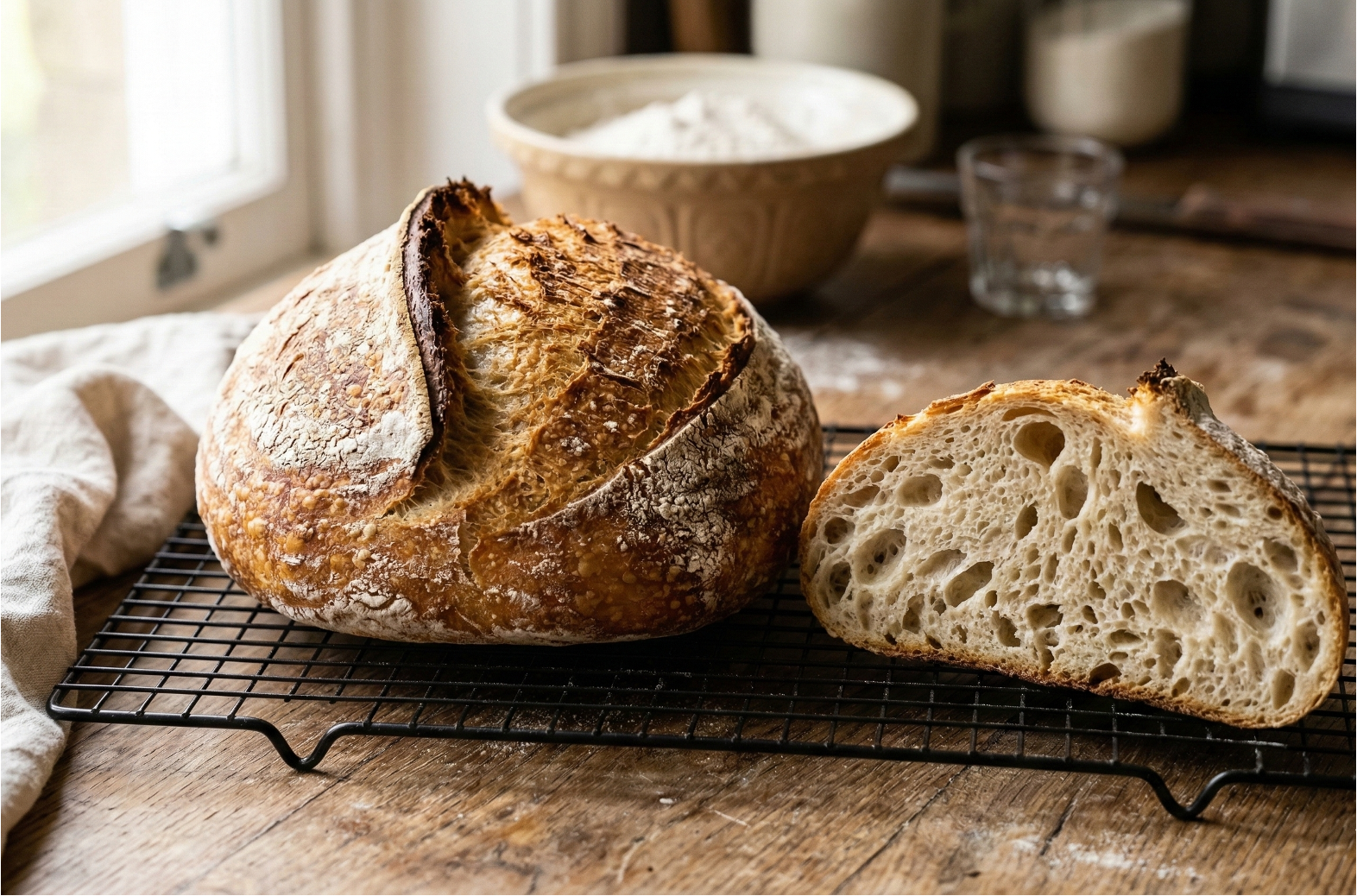
Classic Sourdough Boule
This is THE loaf. The one that makes people say "you made this?!" A beautifully scored boule with a crackling golden crust, an open and airy crumb, and a deep sourdough tang that only comes from a well-fed starter. Perfect with salted butter, or torn apart and dipped into good olive oil.
Ingredients
Levain
- 25g active sourdough starter (from your kit)
- 50g strong bread flour
- 50g water (room temperature)
Dough
- 375g strong bread flour
- 25g wholemeal or rye flour
- 275g water (warm, around 30°C)
- 8g fine sea salt
- Rice flour for dusting
Method
Build the levain
The night before, mix your starter, flour, and water in a jar. Cover and leave at room temperature for 8-10 hours until bubbly and doubled. It should pass the float test: drop a spoonful into water. If it floats, you're ready.
Mix the dough
Combine the flours and warm water in a large bowl. Mix until no dry flour remains. It'll be shaggy and rough. Cover and rest for 45 minutes (this autolyse lets the gluten develop while you do nothing).
Add levain and salt
Spread the levain and salt over the dough. Squeeze and fold it through until fully incorporated, about 2 minutes of squelchy kneading. The dough will feel tighter and more elastic.
Stretch and fold (bulk ferment)
Over the next 3-4 hours, perform 4-6 sets of stretch and folds, spaced 30 minutes apart. Wet your hand, grab one side of the dough, stretch it up and fold it over itself. Rotate the bowl 90° and repeat 4 times per set. The dough will transform from slack and sticky to smooth, pillowy, and jiggly.
Pre-shape
Gently turn the dough onto an unfloured bench. Using a bench scraper or your hands, shape it into a loose round by tucking the edges underneath. Let it rest uncovered for 20 minutes. This relaxes the gluten for the final shape.
Final shape
Lightly flour the top of the dough and flip it over. Pull the bottom edge up to the centre, then the left and right sides, then the top, like folding a parcel. Flip it seam-side down and drag it gently towards you on the bench to build surface tension. You want a taut, smooth top.
Cold proof
Dust a bowl or banneton generously with rice flour. Place the dough seam-side up into the banneton. Cover tightly with a shower cap or plastic wrap and refrigerate for 8-16 hours. This slow cold ferment develops incredible flavour and makes scoring easier.
Preheat and bake
Place a Dutch oven (lid on) into your oven and preheat to 250°C (480°F) for at least 45 minutes. Turn the dough out onto baking paper, score with a sharp blade or lame in one confident motion. Carefully lower into the screaming-hot Dutch oven, cover with the lid, and bake for 20 minutes.
Finish and cool
Remove the lid, reduce heat to 230°C (450°F), and bake for another 20-25 minutes until deeply golden and the crust looks almost too dark (it's not, that's flavour). The internal temperature should read 98°C (208°F). Let it cool on a wire rack for at least 1 hour before slicing. This is the hardest part.
Pro Tips
The dough temperature matters more than the clock. Aim for 24-26°C during bulk ferment. Warmer = faster rise, cooler = slower.
Don't skip the cold proof. It develops the complex, tangy flavour that makes sourdough special and makes the dough much easier to score.
Score with confidence. A single deep slash at a 45° angle gives the best ear. Hesitation = tearing.
If your dough spreads flat instead of holding shape, it's likely over-fermented. Next time, shorten the bulk ferment by 30-60 minutes.